
Yellow jacket nest in wall
Yellow jacket nest in wall? We treat it from the void.
A yellow jacket nest in wall voids is the one wasp job you genuinely can't do yourself. By late August the colony behind your siding is the biggest it gets all year, and the hole you can see is usually not the only way in. We find every entry, treat into the void at dusk or dawn when the colony is home, then treat the cavity itself so next spring's queen skips it. Everett, Marysville, Lake Stevens, Lynnwood, and the rest of Snohomish County.
Call now (425) 332-6566Get a free quote
Step 1 of 2Wall-void colonies at a glance
What a yellow jacket nest in the wall of a house actually is.
It's a paper nest in the cavity between your siding and your drywall, hung off a stud, reached through one gap the colony found in April. By the third week of August it can hold a few thousand workers and fill a bay between two studs, which is why a wasp nest in the wall of a house goes from unnoticed to a phone call in a week.
Late August is also when the colony changes behavior. The queen has stopped laying and the workers switch from hunting insects to scavenging sugar, so they turn up at the trash and your soda can and the traffic at the entry gets impossible to ignore. The window closes around the third week of September.
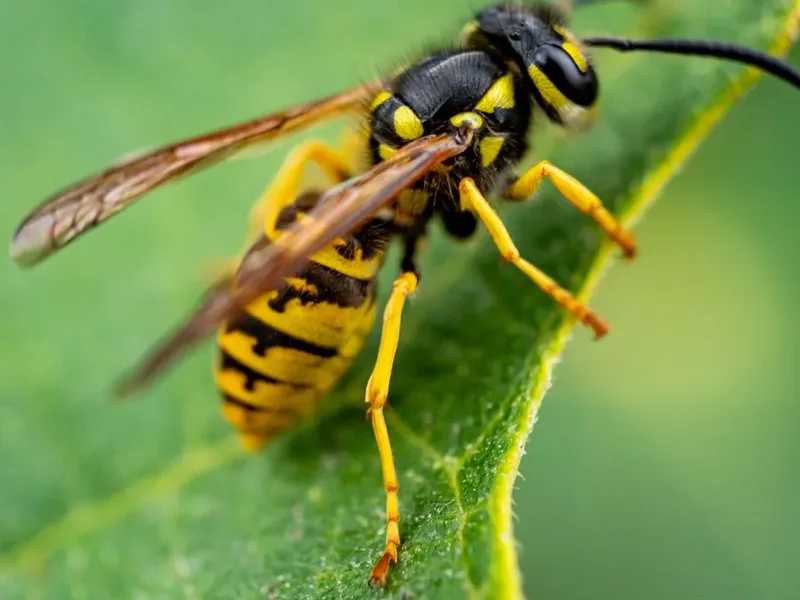
- What it is
- A live yellow jacket colony nesting in the void behind your siding, soffit, or trim
- Colony size now
- Biggest it gets all year. Late August through mid-September is peak
- The mistake to avoid
- Plugging the entry hole. Blocked outside, they chew inward and open into a room
- How we handle it
- Every entry located, treated into the void at dusk or dawn, then the void itself treated
- How fast we respond
- Priority scheduling, with someone out to treat within 48 hours
- Where we treat
- Everett, Marysville, Lake Stevens, Lynnwood, and across Snohomish County
What to watch for
Five signs of yellow jackets in siding: staining, the smell, and buzzing at night.
Wasps on the wall are normal in August. Wasps in the wall are a different problem, and these five separate them. Two or three together and it's in the void.
- 01
A steady two-way stream at one small opening
Not wasps drifting along the wall. A committed line in and out of one gap, all day, from the same flight direction. That is a colony, not a patrol.
- 02
A greasy brown stain spreading below the hole
Yellow jackets in siding leave a wet-looking mark below the entry as the nest grows and the void warms. On light trim it reads as a drip line nobody can explain.
- 03
A sweet, sour smell in the room on that side
The yellow jacket nest in wall smell is warm nest, larvae and spoiled scavenged sugar. It builds on hot afternoons, and it is the second thing people describe on the phone.
- 04
Buzzing inside the wall at night, when nothing is flying outside
Put your ear on the drywall after dark. Outside is quiet, but there is a low rustle behind the plaster. That is the colony at home, and that is the call we get.
- 05
Wasps appearing indoors with no way in
One or two a day in a room on that wall, no open window, no gap. They are coming through an outlet box, a can light, or the top plate. The nest is already large.
How to find a yellow jacket nest in a wall, and the openings people miss.
Watch the traffic, not the wall. Stand back thirty feet on a warm afternoon and give it ten minutes. The flight line is far easier to spot than the gap, which is often no wider than a pencil, and it's rarely a hole in the siding: it's an uncaulked seam, the gap behind a dryer or bath vent, a hose-bib or cable penetration, the soffit return, or the void behind loose trim.
Then look for the ones people miss. A big colony often works two or three openings on one face, and a spare entry at the top plate keeps the wall active after the main one is treated. That's why DIY half-works. We mark every opening on the elevation before anything is treated.
Plugging the hole: the mistake that puts them in your bedroom.
Do not seal the entry. It's the most common thing we get called out to fix, and the one that turns a wall problem into a house problem. Foam, caulk, steel wool, tape, same outcome. Yellow jackets locked out of their own nest don't go elsewhere, they chew, and drywall paper is softer than the siding you just sealed.
What follows is a week of wasps at the bedroom ceiling, through an outlet box, a can light, or a fresh hole in the closet corner. If you've already sealed it, tell us when you call: it changes how we approach the wall. Our walkthrough on how to remove a wasp nest covers which nests are safe to handle yourself and which are not.
Why a hardware-store can sprayed at the entry never reaches a wall colony.
A can of wasp and hornet spray is a contact product with a twenty-foot jet, built for a nest hanging in the open where you can wet the whole thing from the ground. Point it at a gap in your siding and the jet hits the back of the sheathing and coats an inch of tunnel. The nest sits further back in the bay with the queen and the brood in the middle of it, so nothing you sprayed reached them.
What you did do is kill the workers at the doorway and turn several hundred more defensive against the closest moving thing, which is you, on a ladder. What works in a cavity is a dry formulation the colony walks through and carries back, and that isn't sold in a can.
How we work
How we treat a wall-void yellow jacket colony.
Three parts, and the third decides whether you're doing this again next August. Wasp nest removal on an open eave is one visit and one nest. A wall is an elevation, a cavity, and a season.
Every entry located
We walk the whole elevation, not just the hole you pointed at, and mark every opening in use. Satellite entries at the top plate, the soffit return and the vent penetrations are what keep a wall active after a partial treatment.
Treated into the void
At dusk or dawn, when the foragers are home and the colony is inside. We treat into the cavity through the openings the wasps already made, so the workers carry it back to the nest and the queen. The siding stays on.
The void itself treated
Once the colony is down we treat the cavity, because a void that housed one nest is one a new queen will like in April. This is the step DIY never reaches, and it's the difference between fixing this year and fixing the wall.
Wall-void jobs get quoted per property once we've seen the entry point, so tell us which wall and request a free inspection and we'll come look before anything is agreed.
Do we have to open the wall?
Almost never, and it's usually the first question people ask. The colony built its own doorway and we use it, so the nest dies where it sits. No siding comes off, no drywall gets cut, nothing to patch. The nest paper stays in the cavity, which is fine: it's annual, it won't be reused, and it dries out over winter.
The exceptions are rare, like a multi-season nest inside a soffit or a wall somebody already sealed. If that's your situation we'll say so on site, you'll decide, and opening a wall is carpentry rather than pest control.
What happens on the day, and what we need from you.
The treatment is short: twenty to forty minutes on site. Timing is the awkward part rather than the work, since dusk and dawn are when the colony is home, so we book one end of the day rather than the middle.
What helps us most is knowing which wall, when the traffic is heaviest, and whether anything has been sprayed or sealed already. On the day, keep the windows on that side shut, bring the pets in, and stay off that elevation. Traffic drops off within a day and stops over the next two or three.
Response time, the license, and the warranty re-treat.
We guarantee someone out to treat within 48 hours, and stinging insect calls sit at the front of the schedule. If anyone in the house is allergic, say so on the phone and we'll move you up inside that window. You get a text thirty minutes before we pull up and a written report of what we found and used.
Brian holds a Washington State Commercial Applicator pesticide license, number 112338, issued by the Washington State Department of Agriculture. It's a public record, so you can check it rather than take our word for it.
If the wall is active again inside your warranty window we come back and re-treat at no charge, inside the same 48 hours, no argument. On a wall colony that matters more than most, because a missed satellite entry is the failure mode.
Not sure what you've got?
Bees in the wall of my house is the way people usually describe it on the phone, and about a third of the time it really is honey bees, which we don't treat. Our guide to telling yellow jackets, paper wasps, and honeybees apart will settle it in a minute, and for open nests under an eave or in the ground the parent page on wasp nest removal and hornet control covers the rest of what we treat.
Where we work
Wall-void wasp removal across Snohomish County.
We run out of Lake Stevens across more than 35 cities in Snohomish and King County. Wall colonies cluster where the housing stock does: cedar lap siding in older Everett pest control neighborhoods, unsealed vent penetrations on newer Marysville builds, and soffit returns on the split-levels through Lynnwood and Mill Creek. Closer to home base, our Lake Stevens pest control page covers what we see most on this side of the lake.
Mature trees across Lake Stevens keep wasps, yellow jackets and bald-faced hornets busy from June through September, and Lake Stevens yellow jacket removal treats the nest and the entry.
In Lynnwood, nests go up in eaves, play structures and the gap behind the siding, and wasp control in Lynnwood can usually happen inside the 48-hour window.
Edmonds' mature trees and older eaves give paper wasps and yellow jackets plenty of places to build, and wasp nest removal in Edmonds is done at dusk.
Wooded property lines in Woodinville hide yellow jacket and hornet nests until someone mows near one, which is why Woodinville yellow jacket removal starts with finding the nest.
Around Silver Lake and Everett's newer neighborhoods, nests go up in eaves and play structures every summer, and wasp control in Everett gets priority on the schedule.
Questions, answered
Questions about a yellow jacket nest in a wall.
Still not sure what's behind the siding? Send a photo of the entry or call and describe what you're hearing, and we'll tell you what it is.
(425) 332-6566-
How do I find a yellow jacket nest in a wall?
- Stand back thirty feet at midday and watch the wall for ten minutes. Yellow jackets fly a straight, repeated line to one small opening, so the traffic shows you the entry long before you can see the hole. Check siding seams, dryer and bath vents, hose-bib and cable penetrations, and the soffit return.
-
Should I plug the hole where yellow jackets are getting into my siding?
- No. It is the one move that reliably turns an outdoor problem into an indoor one. Yellow jackets sealed out of their own nest do not leave, they chew, and drywall paper and insulation backing are softer than the siding you just caulked. The next opening they make tends to be into a bedroom.
-
What does a yellow jacket nest in a wall smell like?
- Sweet and slightly sour, like fruit going over, with a damp cardboard note behind it. It comes off the nest paper, the larvae, and the sugars the workers bring back in late summer. It is strongest on warm afternoons and on the interior wall closest to the void.
-
How long can yellow jackets live trapped in a wall?
- Sealed in with the nest intact, workers keep going for days and spend that time chewing for a way out, usually inward. Even once the colony dies, the nest, the larvae, and the dead workers stay in the void. That is why sealing is not a treatment.
-
Is it bees in the wall of my house or yellow jackets?
- Look at the body and the traffic. Honey bees are fuzzy, amber and brown, and a hive in a wall shows heavy, unhurried traffic plus wax and honey staining. Yellow jackets are smooth, bright and faster, and their numbers build through summer. We do not kill honey bees, so if it is bees we will point you to a beekeeper.
-
Why do I hear buzzing inside the wall at night?
- Because that is when the colony is home. Foragers are out in daylight, so the void is quietest in the afternoon and loudest after dark, which is the opposite of what people expect. A low, shifting rustle behind the drywall at 10pm with nothing flying outside is close to a positive ID.
-
How fast can you get out to a yellow jacket nest in a wall?
- Stinging insect calls are priority work and we guarantee someone out to treat within 48 hours. If anyone in the house is allergic, say so when you call and we move you to the front of that window. Tell us which wall and when the traffic is heaviest and we can plan the visit before we arrive.
-
Will they come back to the same wall next year?
- Not the same colony. A yellow jacket nest is annual and the workers die off with the first hard frosts. But a void that worked once works again, and a new queen hunting a cavity in spring will find the same gap. Treating the cavity after the colony is down is what breaks the cycle.
Ready when you are
Get it out of
the wall.
Don't seal the hole and don't empty a can into it. Call us, tell us which wall, and we'll have someone out to treat within 48 hours.